Build lifecycle marketing around better decisions.
EngageMKTG was built to help teams turn fragmented customer data into current, explainable, privacy-aware decisions while keeping human goals and judgment in control. Marketers have plenty of tools; the missing piece is often shared context about whether a person should receive a message, what it should say and when the right decision is to wait.
Our approach starts with a measurable application and the systems you already use. Connect the necessary customer context, make the decision rules reviewable and inspect the result before expanding. That puts the business question ahead of a larger migration or an unmeasured promise about what AI will deliver.
Updated
What we believe
A shared decision layer should connect the tools. Identity, events, campaign rules and channel execution often sit with different teams. A reusable decision layer gives them a common basis for action without forcing a full stack migration. The first goal is a flow people can explain, including the reason a message was suppressed.
Privacy context belongs in every decision. A person can have several subscriptions with different permissions. Connecting identity should preserve those distinctions, and a newer bounce or unsubscribe should affect the next proposed send. Interest, timing and predictive scores only matter after the relevant eligibility checks pass.
Adoption should be incremental and AI explainable. Start with one application, agree on a baseline and change the plan when the evidence changes. Humans define strategy, goals, ethics and brand judgment; systems support pattern recognition, timing and repeated operational work. Teams train both the machines and the people who review their output.
EngageMKTG vs a CDP vs an ESP vs an agency
These are roles in an operating model, not universal claims about every vendor. Capabilities overlap and depend on the product or engagement. The useful question is which responsibility your team needs to add while keeping existing systems in place.
| Decision | EngageMKTG | CDP role | ESP role | Agency role |
|---|---|---|---|---|
| Starting point | One measurable application | Existing customer-data context | Existing channel execution | Agreed strategy or delivery scope |
| Migration | Connect the existing stack | Can remain a data source | Can remain the sending tool | Can remain the delivery partner |
| Shared decisions | Decision layer across tools | Supplies relevant profile context | Executes connected actions | Defines or operates agreed workflows |
| Explainability | Reviewed inputs, rules and reasons | Source context is mapped | Execution evidence is inspected | Humans review strategy and results |
| Consent | Checked for each proposed action | Retain permission source | Respect suppressions in execution | Preserve the agreed permission boundaries |
The platform explains the shared components; List Revival shows an entry application. Implementation Services handles the connections when a team needs help turning the model into a verified flow. A CDP, ESP and agency can all remain part of that workflow.
Privacy-first in practice
The platform uses US data residency and profile-centric permission context. Consent and current suppression state are checked before every send in the decision workflow. A shared profile does not turn permission for one brand into permission for another, and an engagement signal does not cancel an unsubscribe.
We do not use purchased lists. Everything we send includes one-click unsubscribe. The operating aim is to make leaving the audience easy and keep that decision connected to later actions. The sunset policy guide explains why removing inactive contacts can be the responsible result rather than a failure to recover them.
Privacy also affects the implementation conversation: start by describing sources, volumes and constraints instead of uploading raw customer records into an inquiry. Agree on the data required and access boundaries before connecting systems. See the Privacy Policy for the site's data-handling information.
Human+AI operating model
People own the business goal, acceptable risk, customer relationship and creative judgment. Systems handle recurring pattern work, segmentation and timing within reviewed constraints. Operators need a reason they can inspect and a clear way to stop the workflow when the assumptions no longer hold.
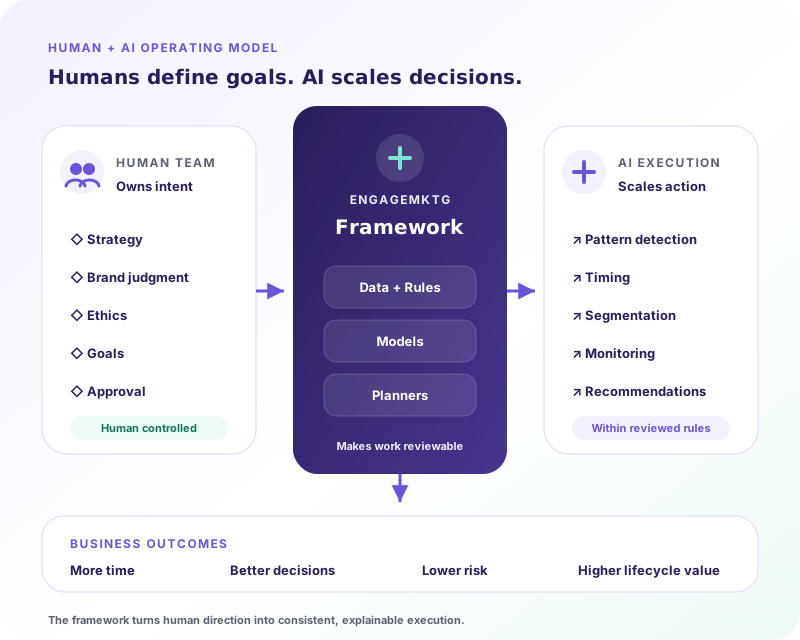
For example, the playbook's stop conditions say to stop a cohort when its hard-bounce rate exceeds 2% and re-scan before resuming. A planner should make that review repeatable, with a named human accountable for the response. It should not optimize past the stop rule to reach a volume target.
The AI+You Community gives marketers, operators, founders and data teams a route to co-develop planners, test integrations and explore early modules. Participation starts with the problem and the feedback a partner can contribute.
Who builds this
Artem Kukharenko
Email marketing & AI systems practitioner · LinkedIn
Artem Kukharenko works at the intersection of email marketing, automation and AI. He builds and operates the systems that connect audience growth, deliverability and customer engagement, bringing strategy, data and implementation together. His writing for EngageMKTG turns technical email challenges into practical decisions, with a focus on clear evidence, responsible list management and measurable outcomes.
How we publish
Articles carry sources and dates so readers can inspect the basis for a recommendation. Living pages include a changelog as provider requirements change. We do not claim results without a defined cohort: planning assumptions, attributed outcomes and measured incremental effects remain distinct. The sender requirements tracker puts that practice to work on changing provider obligations.
FAQ
Do we have to replace our marketing stack?
No. The decision layer connects current customer context to existing tools, beginning with one application and the integrations required to verify it.
Does AI own the strategy?
No. Humans own goals, ethics and brand judgment; systems support repeated pattern and decision work within reviewed constraints.
How do we judge the first application?
Agree on the starting cohort, baseline, stop conditions and measurement window, then inspect actual decisions and meaningful outcomes before expanding.